Homework Calculator
Compute percentages, averages, and GPA in seconds.
Open tool →Find your focus with calm, beautifully crafted study tools — from Pomodoro timers to essay outliners. Built by students, for students who want to do more with less stress.
Ten handcrafted tools to help you study smarter — all free, all in your browser.
Compute percentages, averages, and GPA in seconds.
Open tool →Turn your class notes into instant self-test quizzes.
Open tool →Create, flip, and review flashcards for active recall.
Open tool →Work in focused 25-minute sprints with built-in breaks.
Open tool →Plan your week, set priorities, and never miss a deadline.
Open tool →Structure essays with a clean, argument-driven outline.
Open tool →Paste your syllabus, get every deadline as a calendar file.
Open tool →Add flashcards, and let SM-2 schedule your perfect review time.
Open tool →Combine up to 10 photos — notes, worksheets, scans — into one ordered PDF. No uploads, no sign-up.
Open tool →Build APA, MLA, or Chicago citations in seconds — no sign-up.
Open tool →We're crafting new study tools. Have an idea? Tell us what you need →
No tools match your search. Try another keyword.
Practical, science-backed articles to help you learn better.
Why 25-minute sprints work — and how to customize the cycle for deep work sessions.
Read article →Two powerful learning strategies, demystified — with a weekly schedule template.
Read article →A repeatable framework for thesis-driven essays that win professor feedback.
Read article →Carefully designed templates & planners for serious students.
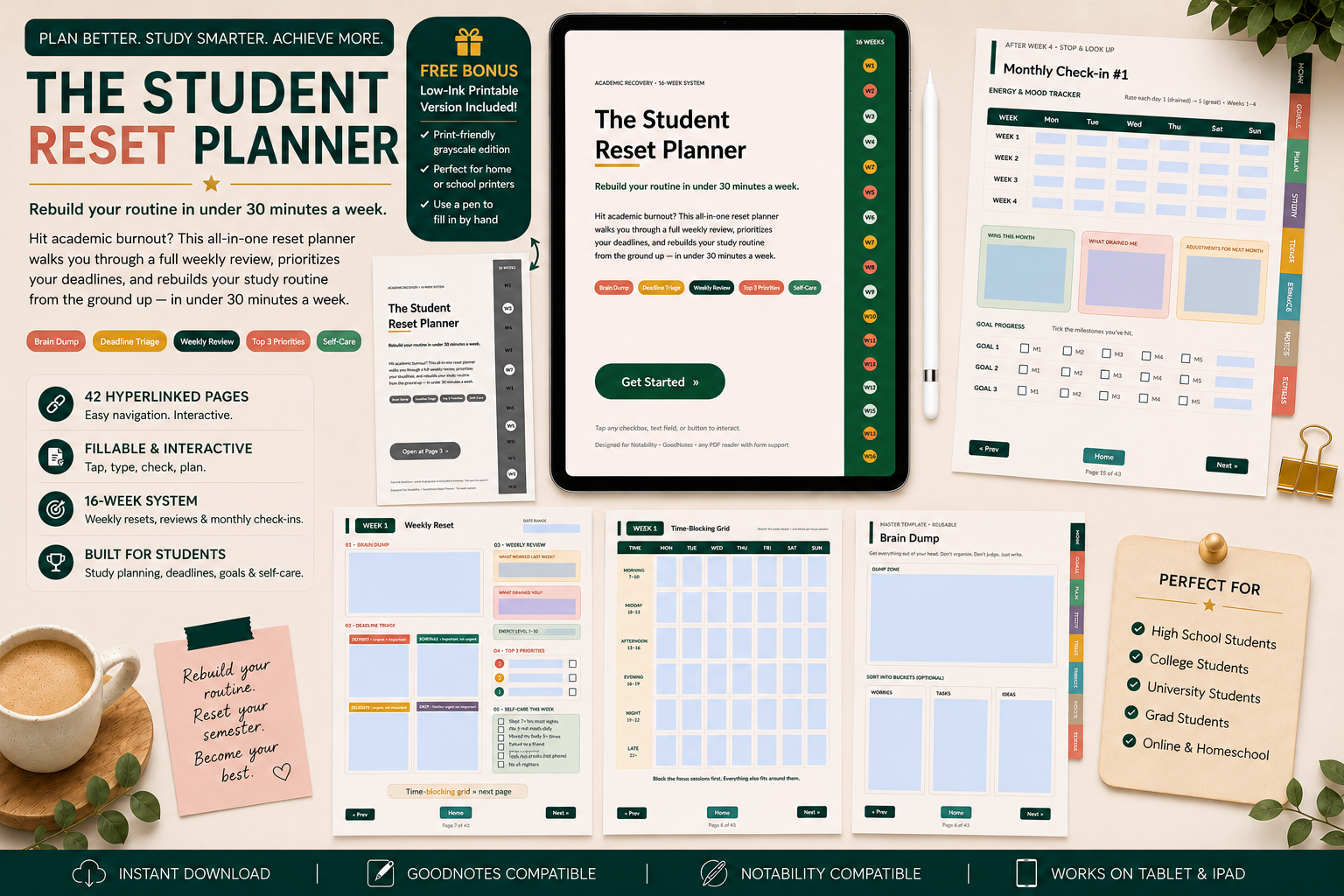
Hit academic burnout? This all-in-one reset planner walks you through a full weekly review, prioritizes your deadlines, and rebuilds your study routine from the ground up — in under 30 minutes a week.
Get the Planner →Build focus, sleep, and study streaks that actually stick. Beautifully designed digital trackers (PDF + GoodNotes) engineered around student energy cycles — not generic productivity bro-science.
🕐 Coming SoonAuto-categorized spending, smart budget envelopes, and a savings dashboard that updates itself. Built for students who want financial clarity without spreadsheets that feel like homework.
🕐 Coming SoonBelow is the canonical layout every tool page follows: interactive tool first, educational article below, premium sidebar, and ad slots — built to satisfy AdSense content-depth guidelines.
The Pomodoro Technique, developed by Francesco Cirillo in the late 1980s, is a time-management method that uses a timer to break work into intervals — traditionally 25 minutes in length — separated by short breaks. The name comes from the tomato-shaped kitchen timer Cirillo used as a university student.
Research in cognitive psychology suggests that brief, focused work sessions align with the brain's natural attention cycles. After roughly 20–30 minutes of concentrated effort, most learners experience a measurable drop in retention and mental stamina. Short breaks allow the prefrontal cortex to reset, reducing cognitive fatigue without sacrificing momentum.
Start with a single, clearly defined task before pressing Start. Vague goals like "study chemistry" tend to fragment attention; instead, try "summarize chapter 4 of the chemistry textbook." When the timer rings, step away from your desk entirely — stretch, hydrate, or look out a window for five minutes.
The classic Pomodoro is 25 minutes of work followed by a 5-minute break, with a longer 15–30 minute break after every fourth session. However, many students find that longer 50-minute sessions suit deep work like essay writing or problem sets. Experiment with 25/5, 50/10, and 90/20 cycles for one week each and track which produces the most sustainable focus.
The most frequent mistake is skipping breaks when you feel "in the zone." While tempting, this often leads to burnout two to three hours later. The second is multitasking during a Pomodoro — even checking a single notification can reset your focus cycle. Treat each session as a single, uninterrupted block of work.
For students who want a structured weekly Pomodoro plan, our Student Reset Planner includes a built-in cycle tracker and energy-level journal so you can identify your peak focus windows.
Study Compass is a calm, ad-supported toolkit built by students who struggled to find beautiful, distraction-free study tools online. Every free tool here is crafted to reduce friction — no sign-ups, no clutter, no dark patterns. Premium resources help us keep the free tools running forever.
We believe the best study environment is the one that fits you. That's why every page adapts to four cozy themes — Morning, Night, Library, and Nature — and remembers your choice on your next visit.